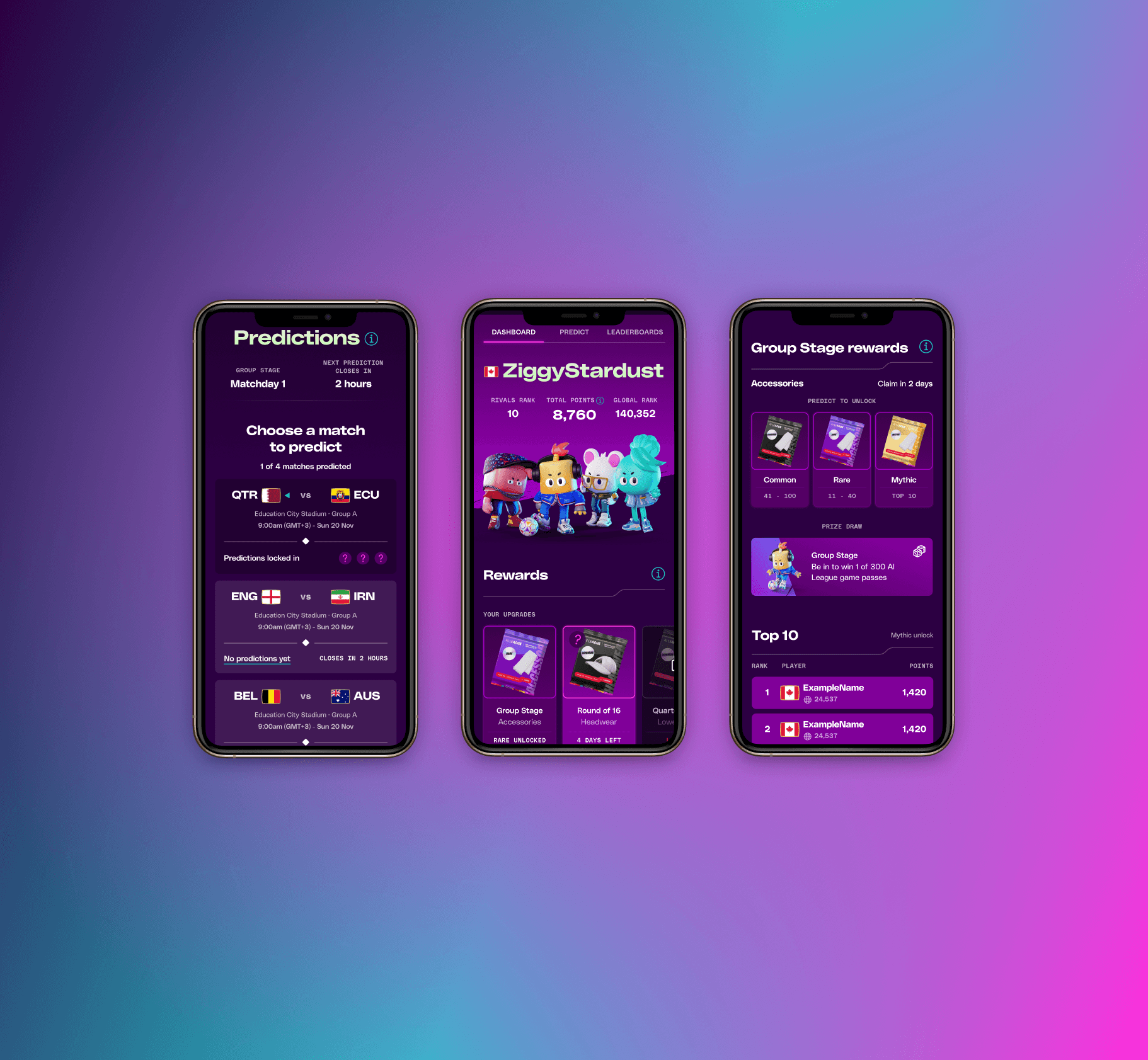
The experience was designed to sit within the FIFA World Cup, a tournament that engaged over 5 billion people worldwide.
With less than 3 months to kickoff, the team designed, tested, and shipped a multilingual fan engagement platform from scratch — in time for the first match.
A repeatable content system enabled consistent translation across multiple languages with zero errors.
By grounding the experience in familiar gaming and prediction patterns, the design invited participation from users with little or no exposure to digital ownership models.
In a nutshell
FutureVerse, Altered State Machine
UX designer, Lead researcher, Lead content designer
2022
The FIFA World Cup AI League was a global fan engagement platform built in partnership with FIFA and Futureverse, designed to bring football fans into an AI-driven prediction and collectibles experience during the FIFA World Cup Qatar 2022 and lead into Futureverse's NFT-based AI League game.
The platform invited fans worldwide to predict match outcomes, earn points, and unlock AI footballer collectibles — with correct predictions determining the value of what they'd receive at the tournament's end.
The challenge
Standing out in the crowd.
Designing a global fan experience that could cut through the noise of the FIFA World Cup and invite participation from people who had never heard of an NFT.
The approach
I joined a cross-functional team of six as Lead Researcher, UX Designer, and Content Designer — holding all three functions across the project.
Collaborating with Design Leads on design decisions and leading content and research independently, my work focused on clarifying the value proposition, simplifying participation, and shaping an experience that felt fun, approachable, and worth returning to throughout the tournament.
The concept
Early ideation explored what kind of experience could stand out during the FIFA World Cup, where fans are already saturated with games and promotions. During rapid co-design sessions, my teammate and I proposed a live participation mechanic — the idea that fans could engage with the tournament in real time.
This contributed to the final core mechanic of match predictions, progression, and rewards, borrowing familiar patterns from fantasy football and progression-based games to make digital collectibles feel immediately accessible.


The research
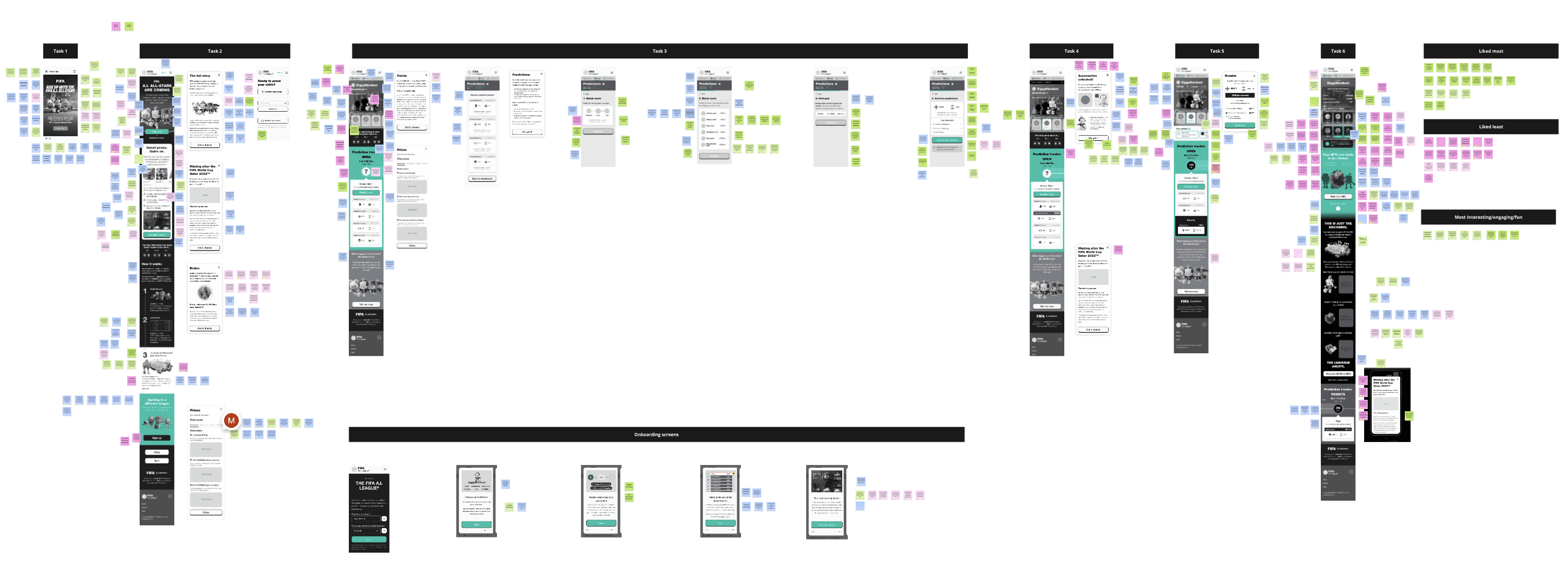
As Lead Researcher, I designed and ran two rounds of lean, fast research under significant time and budget constraints: a few days each, while the UX and visual design were simultaneously fleshed out.
Round 1: 20x unmoderated concept testing
At this point, the concept was still highly fluid, so speed and directional confidence mattered more than depth. I held unmoderated sessions via Userbrain with global participants (UK, US), purposely targeting people with low levels of knowledge about digital collectibles, but high interest in sports and mobile games. The goal was to gather broad signals on the initial concept's first impressions, value proposition comprehension, and motivation to participate.
Round 2: 12x unmoderated and moderated testing
I combined another 10 unmoderated tests with 2 targeted moderated sessions to validate revisions across the full end-to-end journey: onboarding, prediction flows, reward clarity, and supporting content. The moderated sessions were a deliberate budget decision — small in number, but placed exactly where unmoderated testing couldn't give us the depth we needed.

The insights
Assumption: NFT hype would sell itself
An early creative direction leaned heavily on narrative and emotional storytelling to differentiate the platform and tease the broader Futureverse ecosystem. The assumption was that the novelty of NFTs — at their cultural peak in 2022 — would make the value proposition self-evident. We tested it to find out.
Analysis: Users wanted in, but didn't know how
Value must be immediately obvious: Early versions asked users to work too hard to understand what they would gain. If rewards, effort, and outcomes weren’t clear upfront, users disengaged quickly, even when the experience was free.
Known patterns provide guidance: Users responded best when the experience felt closer to known patterns like fantasy leagues and progression-based games. People also got attached to their player avatar, making progression, customisation, and rewards feel meaningful.
Tangible rewards legitimise digital ones: Users were interested in NFTs but couldn't connect to their value when abstract or unexplained. Physical prizes and clear leaderboard outcomes anchored the experience, making digital rewards feel credible and motivating over the course of the tournament.
Synthesis: Familiarity beats novelty
Users didn't need a story — they needed to understand what they were getting and why it was worth their time. The narrative was stripped back, the rewards were made explicit, and familiar patterns did the emotional work instead.


The content
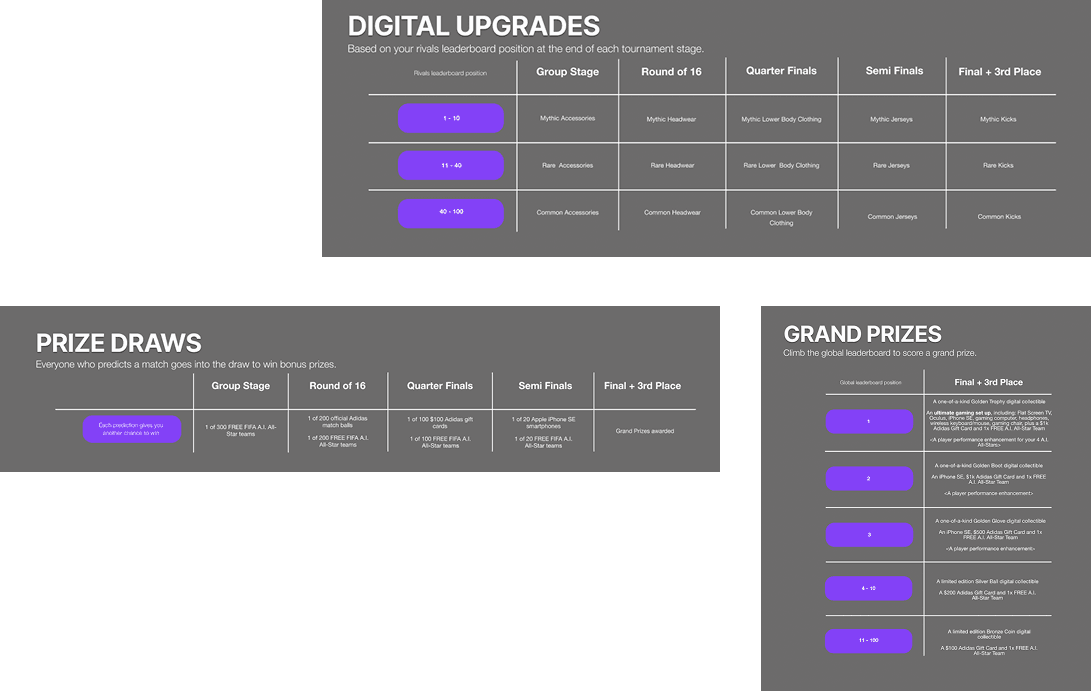
Content documentation: Prizes.
As the sole content designer on the project, I owned the full content experience — from UX writing across every functional touchpoint through to the content framework and style guide that governed the experience end-to-end.
The bigger challenge was scale. A global platform needed content that could survive translation without losing clarity or intent. I structured every content decision around repeatability — constrained terminology, consistent hierarchy, and scannable patterns that reduced translation complexity and gave developers and translators a clean, parseable system to work from. The result was a multilingual rollout with zero errors.


The retrospective
The outcome: Shipped on time, at scale
A global fan engagement platform, designed and launched in under three months, in time for the first match of the FIFA World Cup Qatar 2022. The experience reached tens of thousands of football fans worldwide, delivered across multiple languages and leading directly into the AI League game that received 50,000+ downloads.
The takeaway: Constraints as a creative force
In practice, the three-month constraint made every decision sharper. An early pivot from desktop to mobile avoided weeks of work that would have been stripped away anyway, lean research delivered clarity without slowing the team down, and a tight content system scaled globally without breaking. Speedy, no-return decisions made the product better.
The impact: Better ways of working
The lean research methods developed under pressure didn't stay on this project. Small, targeted rounds of testing designed to extract maximum signal with minimum resource became a reusable model for fast-paced work. The project also sharpened how the team approached cross-functional collaboration at pace, working across design, content, research, and development simultaneously without losing coherence.